
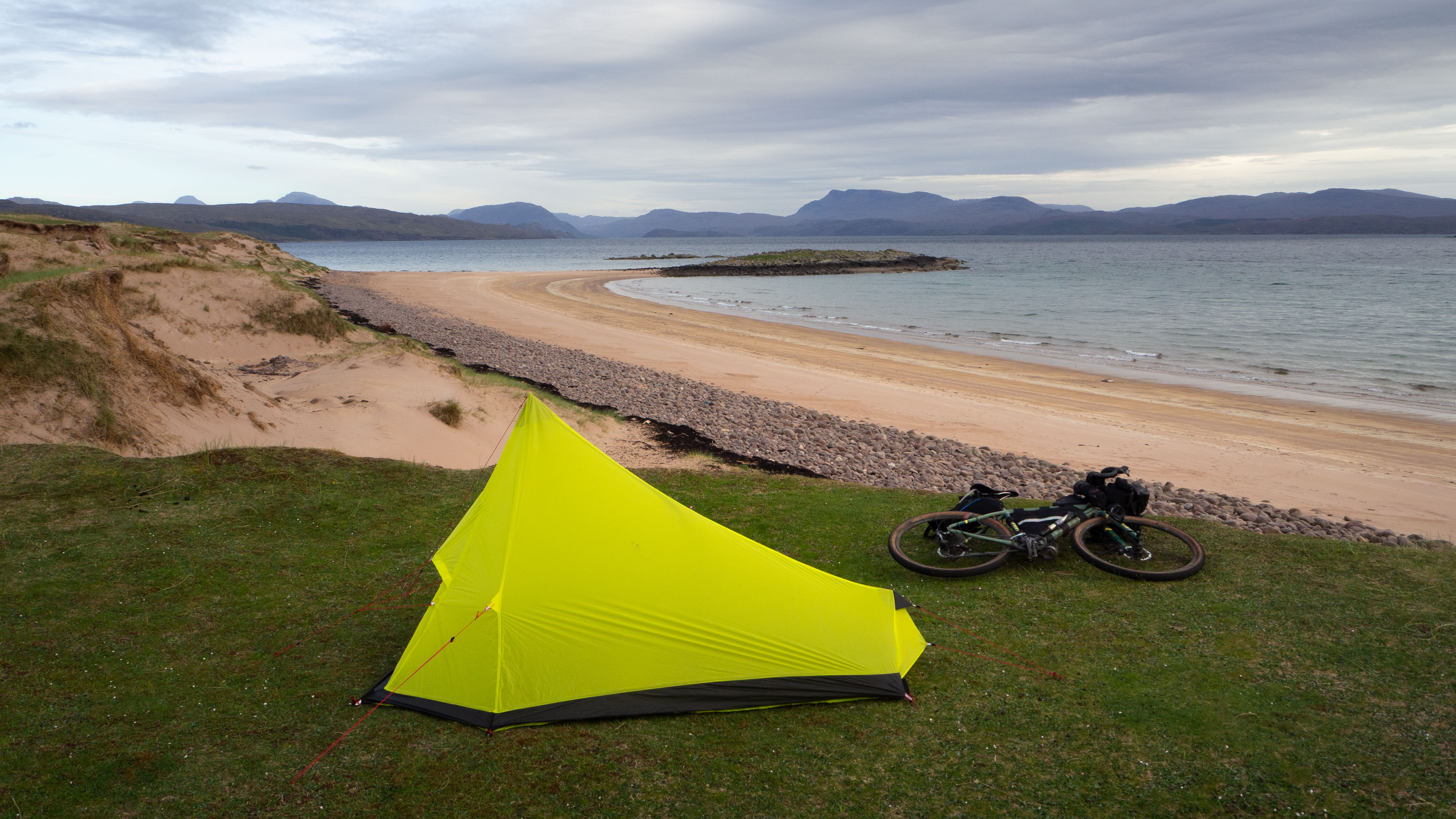
Lightweight tents don't have to cost a fortune! We've rounded up 16 lightweight, affordable models under €200 – some of which we've personally tested on tour – all weighing under 2 kilograms and perfect for bikepacking and cycle touring.
When bikepacking or cycle touring, we want to travel light and avoid lugging around a bulky tent. Space in our bags is limited, and we feel every extra kilo on the climbs.
The problem: Ultralight branded tents often cost €400 or more. That's a lot of money for a bit of fabric and a couple of poles.
The solution: Manufacturers like Naturehike, 3F UL Gear or Decathlon. These brands are well-established and popular in the ultralight community, producing genuinely good tents at a fraction of the price. We've been using several of their models ourselves for years.
In this article, we'll introduce you to what we think are the most interesting tents for bikepacking – all under €200 and 2 kilograms. Organised by manufacturer, with key specs and our personal experiences.
Naturehike Tents – Affordable, Lightweight and Tried-and-Tested
If you're looking for affordable, lightweight tents, you'll quickly come across Naturehike. This Chinese manufacturer has been producing high-quality tents for years, continually refining their designs. Many models are conveniently available on Amazon, meaning your tent can arrive within days. Just make sure you don't accidentally buy an older version. Alternatively, you can order via AliExpress, which takes around 2–3 weeks. You can also order directly from Naturehike's website, though there are plenty of negative reports about that option.
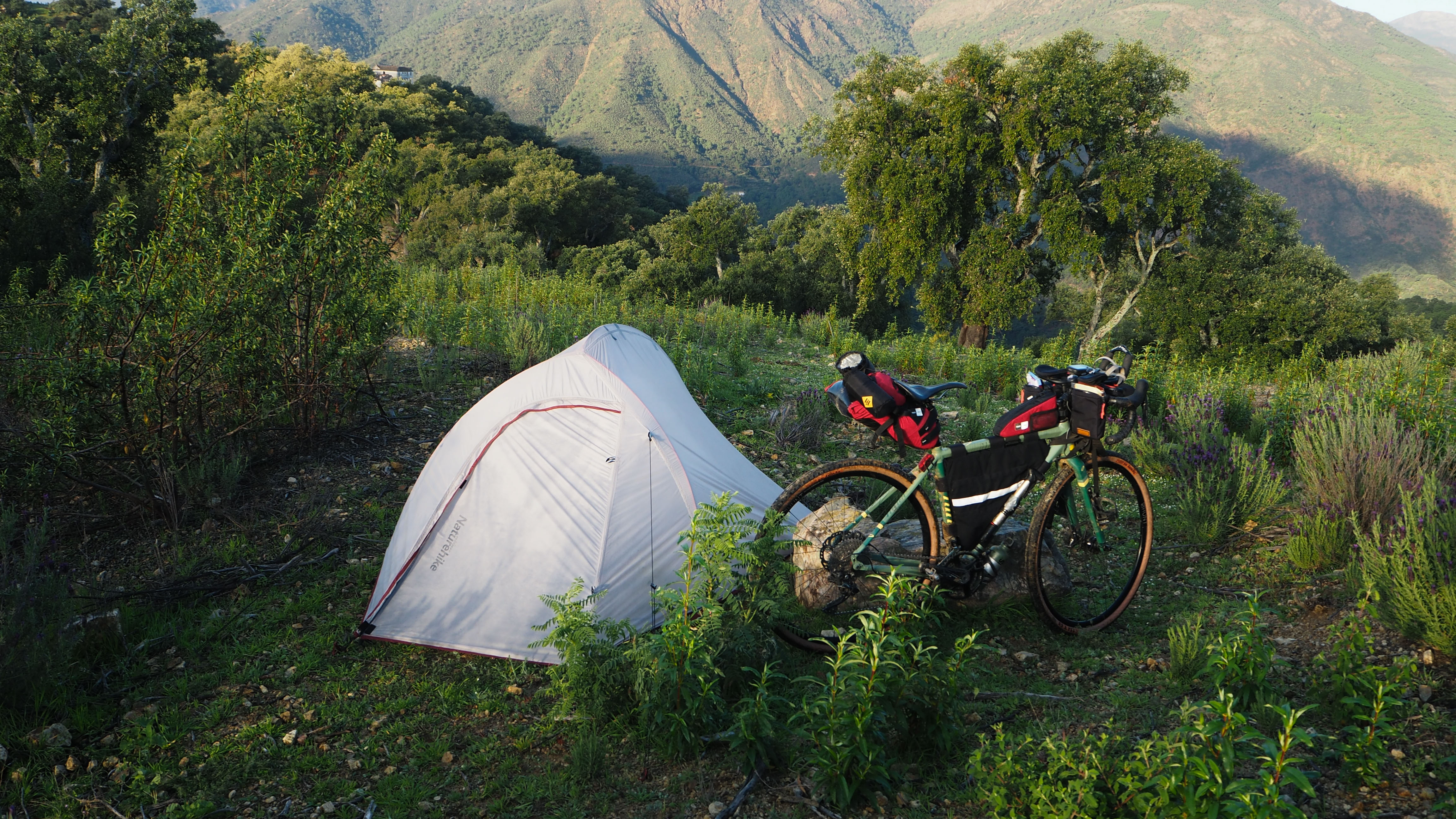
Naturehike Cloud Up – Popular for Good Reason
The Cloud Up is THE classic Naturehike tent. Lightweight (from 1,220g for the one-person version, from 1,350g for two-person), compact, freestanding and affordable. We've been using an older version of the Cloud Up 20D (two-person) for years. Spain, Denmark, Germany, Sweden, Norway – this tent has seen plenty of action.
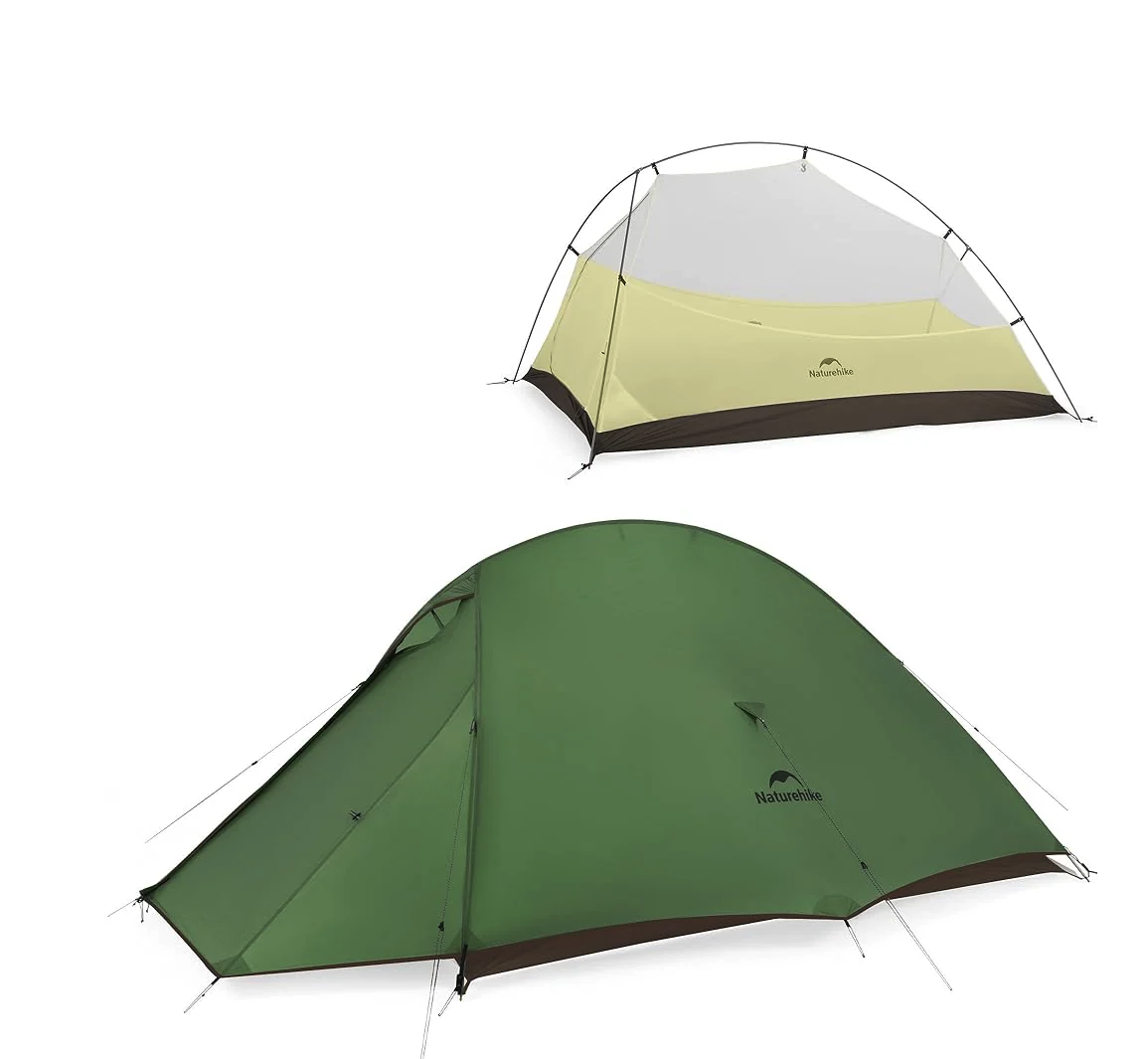
The tent is freestanding – you only need two pegs at the front by the door. The inner tent stands completely on its own. Pitching is dead simple: inner tent first, then the flysheet over the top. The tent comes with plenty of guy lines, and you can add even more. Once properly tensioned, it's remarkably stable in the wind.
A particularly handy feature: the tent is narrow enough that it's much easier to pitch when wild camping in areas with limited flat ground. Perfect for tricky terrain. And if you realise you've picked a bad spot, you can simply pick the tent up and move it.
Space and Size
The one-person version has a sleeping area 80–110cm wide. The two-person version offers just enough room for two mats, with a sleeping area 125–130cm wide. The walls slope inwards, so if there are two of you, you'll inevitably touch the inner tent. The vestibule is also a bit small for two. Length is 210cm. And you can sit up inside, which is worth its weight in gold on rainy days.
The two-person tent is only around 200g heavier than the one-person version. So it's worth asking whether you might want the two-person even if you're solo – you'd have loads of room.
Naturehike supplies the Cloud Up in fairly loose stuff sacks, so it can be packed down considerably smaller, especially if you pack the poles separately. The stated pack size does give you a good indication of pole length though – important when fitting it into your bags.
The three-person version would be better for two people, but it's noticeably bulkier due to more and longer poles.
Pro and UL Versions
The Pro version is an updated Cloud Up. There's also a UL version, built like the Pro but using lighter fabric (15D). These newer models have a taller door. The door on our tent was always a bit low when crawling out or sitting by the entrance, so this is a genuinely welcome change.
However, the inner tent is different too: only the upper half is mesh now. With the inner closed, you can't see out as easily, which would personally bother me. On the plus side, it's probably a touch warmer on cold, windy days – and slightly less well ventilated on particularly warm nights.
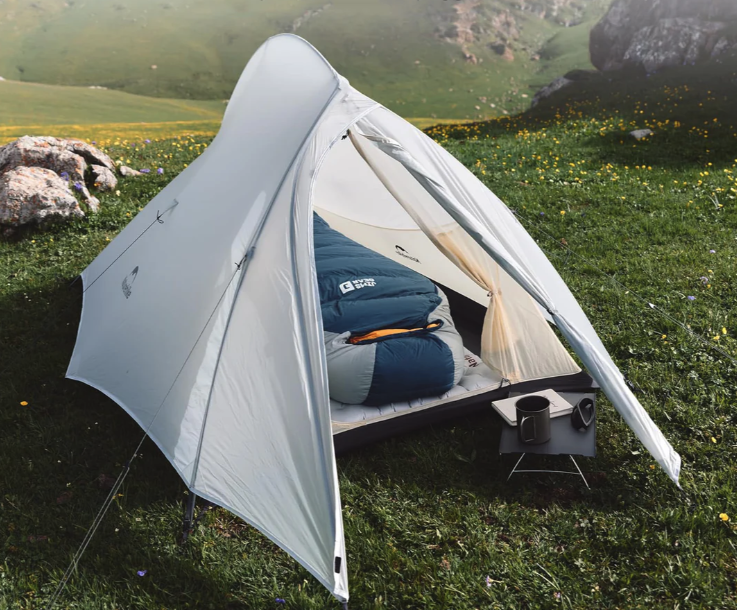
The tent is available in different flysheet materials (20D, 15D and 210T) and as a one-, two- or three-person tent.
The 210T fabric is slightly heavier but doesn't stretch when wet. The 20D and the even lighter, thinner 15D are both silnylon – so you'll need to retension the guy lines when they get wet. On the other hand, silnylon is said to be more durable and tear-resistant than the 210T polyester. The 210T is cheaper, though.
Why Not a Side Entrance?
There's also the Cloud Trek – essentially the Cloud Up but with a side entrance instead of a front entrance. A side entrance is more convenient, no question. However, it adds 100g to the weight. And according to user reports, it's considerably more vulnerable in the wind because there are no guy lines on either side. For that reason, we wouldn't go for the Cloud Trek. If you want a side entrance, have a look at the models further down (Mongar, Star River, Tagar...).
All Cloud Up Models at a Glance
Model | Weight (g) | Packed Size (cm) | Price (€) | Shop* |
Cloud Up UL 1 (15D) | 1.220 | 39 x 13 (Ø) | 140 | |
Cloud Up 1 (20D) | 1.330 | 41 x 13 (Ø) | 120 | |
Cloud Up UL 2 (15D) | 1.350 | 40 x 13 (Ø) | 190 | |
Cloud Up Pro 1 (20D) | 1.360 | 39 x 13 (Ø) | 130 | |
Cloud Up 1 (210T) | 1.500 | 41 x 13 (Ø) | 90 | |
Cloud Up Pro 2 (20D) | 1.530 | 40 x 13 (Ø) | 140 | |
Cloud Up 2 20D | 1.550 | 45 x 12 (Ø) | 130 | |
Cloud Up 3 20D | 1.850 | 51 x 18 (Ø) | 150 | |
Cloud Up 2 210T | 1.900 | 41 x 13 (Ø) | 105 |
Our Verdict on the Naturehike Cloud Up:
A brilliant, lightweight and fuss-free tent. We'd recommend the two-person version even if you're going solo – you get loads of space (and it's only 200g heavier than the one-person!). For two people it's cosy – but that's fine if you're sharing with someone you like!
Naturehike Mongar and Star River – The Roomier Dome Tents
After more space? The Mongar and Star River are classic dome tents – and like the Cloud Up, freestanding apart from the door. The walls rise more steeply, giving you more headroom and more space. The two-person tent here really is a two-person tent – not more like a 1.5-person as with the Cloud Up. The two-person versions have two doors and two vestibules, perfect for cross-ventilation in the height of summer.
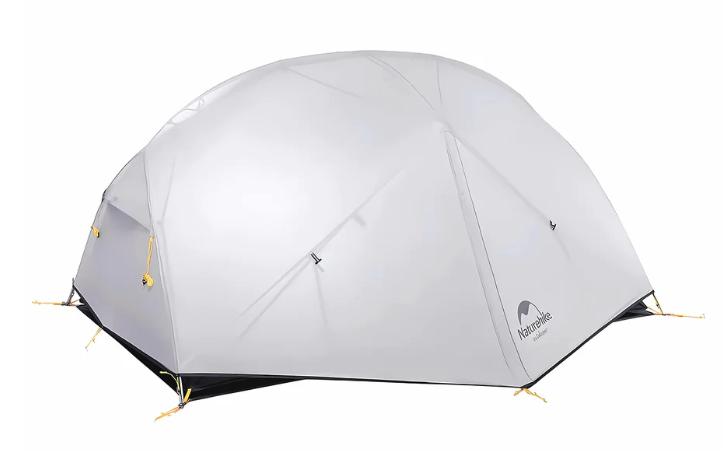
The tent comes in various colours (dark blue, dark green, sand, grey) and, like the Cloud Up, in different materials: 15D, 20D and 210T. The Mongar 1 UL (15D) weighs 1,340g – only 120g more than the Cloud Up UL 1. The Mongar 2 UL (15D) weighs 1,670g, roughly 320g more than the Cloud Up UL 2. A fair trade-off for the extra space. Bear in mind, though, that the Mongar 20D in particular has a noticeably larger packed size than the Cloud Up.
The Naturehike Star River 2 – Almost Identical, but with Subtle Differences
Confusingly, there's another two-person dome tent from Naturehike: the Star River 2, available in 20D and UL (15D). It's nearly identical to the Mongar 2 and, in the 20D version, weighs exactly the same to the gram.
The differences in detail:
The packed size is slightly smaller
The inner tent has fabric on the lower half instead of mesh (more sheltered from wind)
The inner tent doors roll downwards
The dome isn't quite symmetrical – one side is slightly lower, but you get more sitting height
The doors can be guyed out upwards
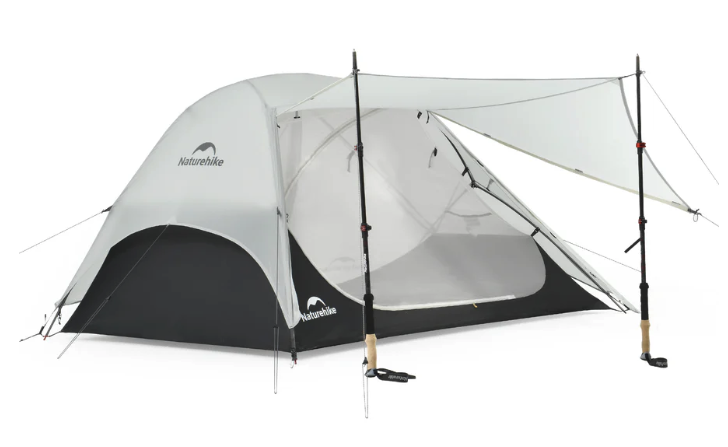
We see a major advantage with the Star River in the UL version: it comes with different stuff sacks. Everything can be stored separately in small stuff sacks that optionally clip together. No bulky bag half-filled with air – just small, manageable pouches that are easy to split between your bike bags.
The UL versions of both the Mongar and Star River also seems to have shorter poles – handy for fitting into your bags.
With the Star River UL, the mesh door panel extends almost to the ground – so you can still see out while lying down. And there's a small pocket in the vestibule for bits and bobs.
Our Verdict: For two people, the Star River 2 UL is our favourite of the Naturehike tents! That said, it's also one of the pricier options on our list.
Naturehike Mongar and Star River Models at a Glance
Modell | Gewicht (g) | Packmaß (cm) | Preis (€) | Shop* |
Mongar 1 UL (15D) | 1.340 | 40x14 (Ø) | 144 | |
Star River 2 UL (15D) | 1.620 | 40x13 (Ø) | 190 | |
Mongar 2 UL (15D) | 1.670 | 41x15 (Ø) | 180 | |
Mongar 2 (20D) | 1.900 | 50 x 15 (Ø) | 115 | |
Star River 2 (20D) | 1.900 | 45x15 (Ø) | 130 |
Naturehike Tagar – Ultralight and Affordable
This tent we find really exciting. It's essentially the ultralight version of the Mongar. It's single-walled, meaning there's no separate inner tent – just mesh panels built into the flysheet. This saves weight and packed size. The Tagar 1 weighs just 1,150g, the Tagar 2 only 1,290g. And they cost roughly €100.
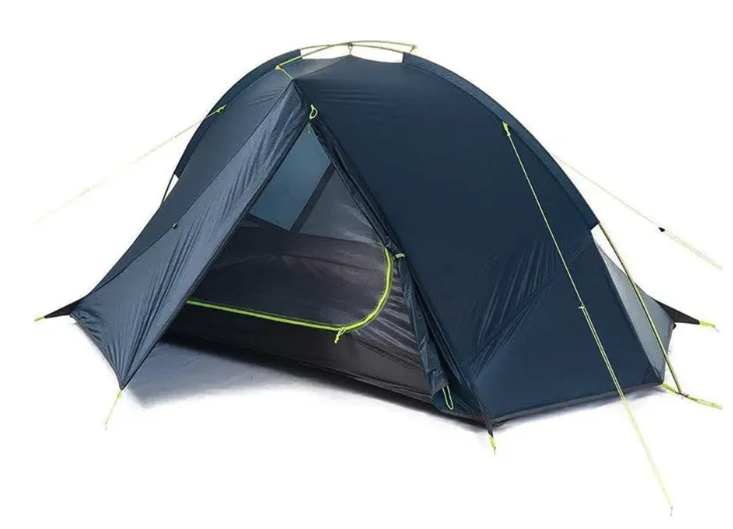
With any tent, moisture condenses on the outer fabric. With double-walled tents, the inner tent protects you from the wet wall. With single-walled tents, it doesn't. In the worst case, condensation runs down onto the tent floor. Or in a storm, droplets get shaken into the tent. And if your sleeping bag touches the wall, it gets wet.
That said, the current version of the Naturehike Tagar appears to be well designed. There are small mesh vents on both sides and at the foot end for ventilation. And at the top on the side opposite the door as well.
I've been using a single-walled tent for years (featured further down, the 3F Lanshan Pro) and haven't had any major issues. If needed, you can just wipe the water away with a small towel.
What Else You Should Know About the Tagar
Unlike the Mongar, the Tagar isn't freestanding. You'll need to get at least the pegs at the four corners and the door into the ground.
The two-person version has only one door. Even so, there's still a bit of storage space on the other side and at the foot end.
The tent packs down considerably smaller than Naturehike's stated size – especially if you store the poles separately. The poles are on the longer side, though.
For storms, there are plenty of guy-out points. User reports are very positive about its wind stability.
Naturehike Tagar: Models at a Glance
Model | Weight (g) | Packed Size (cm) | Price(€) | Shop* |
Tagar 1 (20D) | 1.150 | 44x10 (Ø) | 100 | |
Tagar 2 (20D) | 1.290 | 44x10 (Ø) | 100 |
Our Verdict on the Tagar: Extremely interesting for cycle tourists, especially given the low weight and bargain price. But you shouldn't be put off by a bit of condensation. And if there are two of you, make sure you like each other :)
Naturehike Daban 1 – Under One Kilogram!
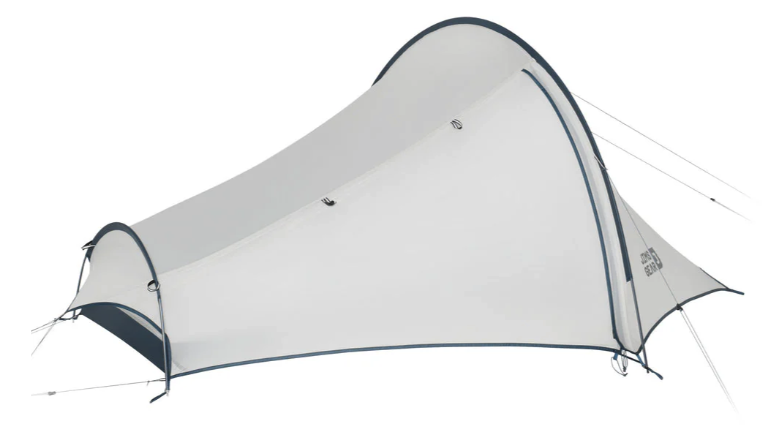
Like the Tagar, it's single-walled – so you'll need to cope with a bit of condensation. That said, it has some clever ventilation features.
Thanks to its shape, the tent offers plenty of space for one person.
The stuff sack is 40x15cm, but very loosely packed. So the tent can be packed down even smaller.
What You Should Know
Unlike all the other Naturehike tents, the Daban doesn't come with an additional groundsheet. The pegs are apparently not the best, according to user reports – it might be worth buying different ones.
Model | Weight (g) | Packed Size (cm) | Price (€) | Shop* |
Daban 1 | 997 | 40x14 (Ø) | 172 |
Our Verdict: Interesting for solo travellers who want a wind-stable, ultralight tent. We haven't tested this tent ourselves yet – but we'll be putting that right!
Tents from Decathlon
Simond MT900 – Decathlon's Lightest
No article like this would be complete without the Simond MT900 from Decathlon. A small dome tent, freestanding, just 1,300g and with a packed size of only 39x10.5cm. Those are excellent specs, especially the packed size.
One mat fits in, just about. So there's not much room, but there's enough height to sit up. On the plus side, it has a large vestibule with a groundsheet.
Pitching is simple: inner tent first (freestanding), then the flysheet over the top. Reviews are mostly very positive.
Decathlon Simond MT900 at a Glance
Model | Weight (g) | Packed size (cm) | Price (€) | Shop* |
Simond MT900 | 1.300 | 39x10,5 (Ø) | 189,99 |
Our Verdict: Certainly not a bad choice if the size is enough for you. The packed size is superb! And you can buy it directly in store at Decathlon.
Tents from 3F UL Gear – Popular in the Ultralight Community
3F UL Gear is another Chinese manufacturer, founded in 2008 by mountaineers. The name 3F comes from a beginner-friendly mountain in western China. They're even less well known in Europe than Naturehike, but they're hugely popular in the ultralight community. Their tents have thousands of fans worldwide – our author included.
3F UL Gear regularly improves their tents, so it's worth making sure you get the latest version. Ordering directly from their website usually works without any issues, and their customer service responds quickly to questions. Delivery takes around 2–3 weeks.
A word of caution: There are only two official domains – www.3fulgear.com and www.3fulgear.co.uk. According to the manufacturer, all other sites imitating 3F UL Gear are scam sites. Counterfeit versions of their tents are also in circulation. So be careful!
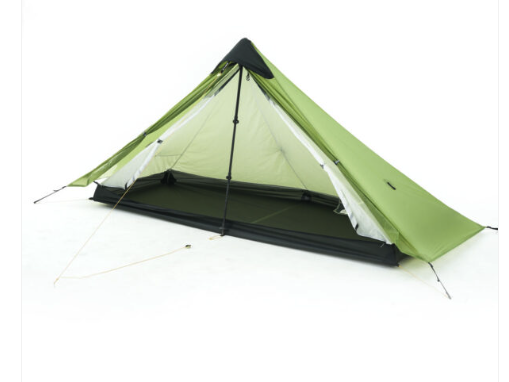
Now for 3F's most popular model, the Lanshan. You'll find this tent in every ultralight forum and all over YouTube. It really is popular. And that's because it's incredibly light. And because it doesn't use poles. You pitch it using trekking poles – ideal for anyone who also hikes. As a cycle tourist, you pack lightweight aluminium or carbon poles instead. The tent offers sitting height inside and plenty of space. In the one-person version, there's still loads of room beside your mat for storing gear (plus the vestibule), and the two-person is roomy as well. However, it's not freestanding.
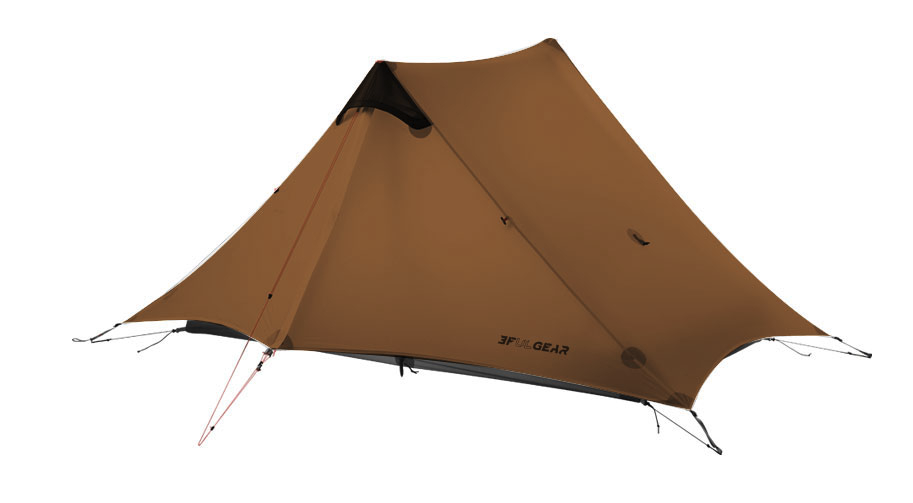
Lanshan Pro or Standard – What's the Difference?
The tent comes in a Pro and a standard version. The Pro is single-walled, so it only has a built-in mesh panel. We explain the drawbacks further up under the Tagar. The standard version has a proper inner tent that clips into the flysheet. This makes it easy to pitch in the rain. But you can also pitch just the inner tent on its own.
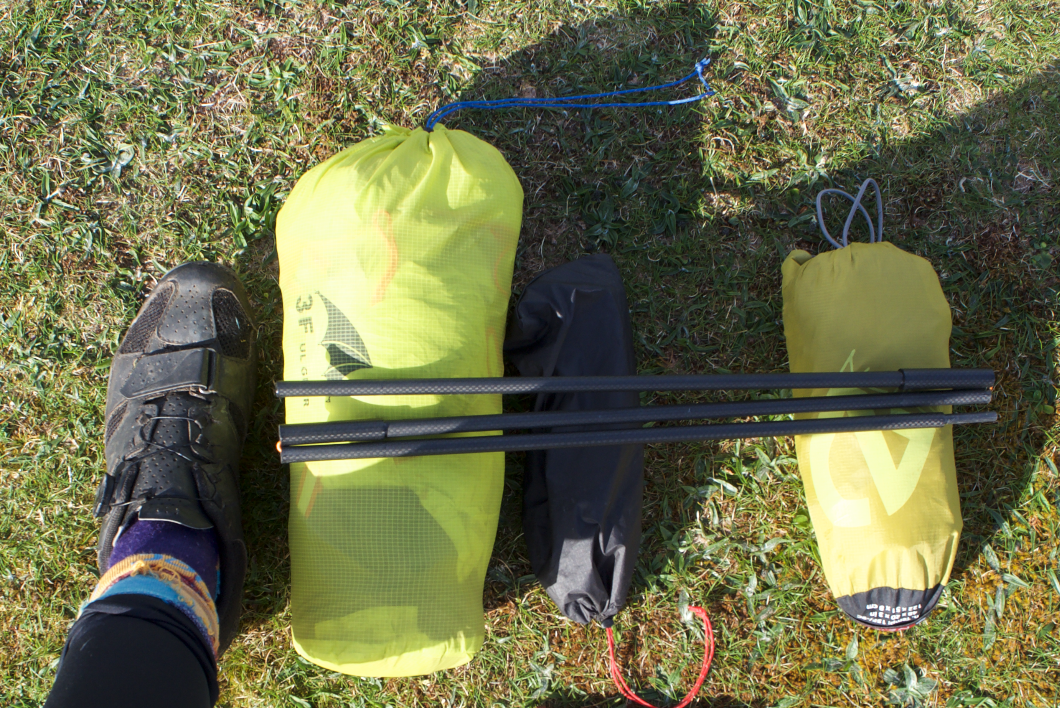
The lightest single-walled model, the Lanshan 1 Pro, weighs only around 910g including a carbon pole. That's pretty hard to beat. The double-walled Lanshan 1 weighs less than 100g more – and then you have a proper inner tent. The packed size is also exceptional for this price range – the stuff sack can be compressed with two straps, so you can really get it down to an absolute minimum. It packs down incredibly small, and the short pole fits nicely in a frame bag.
Our Experience – Thoroughly Tested
I've been using the predecessor of the Lanshan 1 Pro for many years. It's already been through a Scotland cycle tour and countless bikepacking trips. Since then, the manufacturer has made numerous improvements.
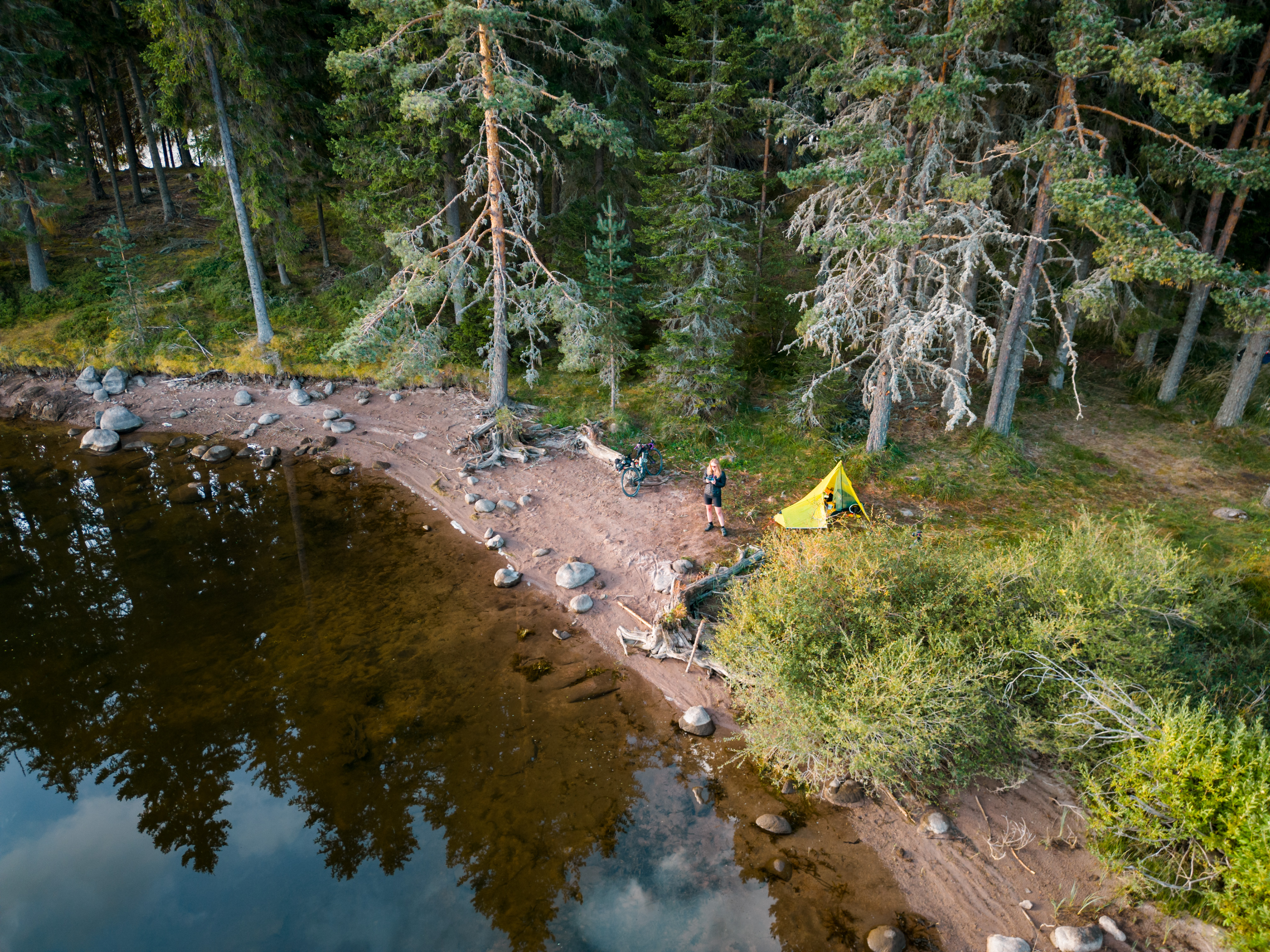
Sure, in certain weather conditions the condensation runs all the way down – that's a known issue with single-walled tents. It's quick to wipe away with a small microfibre towel. More annoying is that with the Pro, it's easy for the foot of your sleeping bag to touch the wet tent wall. You have to be really careful.
Important with the Pro: the seams still need to be sealed with seam sealer. You can do this yourself at home – it's not difficult, but it does add a few grams. With the standard Lanshan, the seams are already taped.
For these reasons (barely any weight difference, seam sealing, condensation), I don't see many advantages to the Pro version. So if I were buying again, I'd go for the Lanshan 1 (without Pro).
We've since got the Lanshan 2 as well (without Pro, with inner tent), because for once we fancied going hiking. The Lanshan 2 is very spacious and has two large vestibules. But we've only used it once so far, on an overnighter. Full review to follow! That said, pitching the two-person version really isn't quite as easy. We'd underestimated that a bit. The one-person is much more straightforward.
What You Should Know
The Lanshan isn't freestanding – you need pegs (lots of them!), there's no way around it. Pitching is also a bit more involved than with a dome tent. Watch a YouTube video beforehand, especially for the two-person tent.
As a bikepacker, you'll also need to buy one or two poles separately. We recommend the original carbon poles from 3F, or high-quality ones from ZPacks or other reputable brands. We had a bad experience with cheap no-name poles from China – one snapped on the second pitch. But a good carbon pole is solid! Pay attention to pole length too, so it fits nicely in your bags. You can also put together your own poles at Extremtextil.
Night Cat – The Lanshan Clone
On Amazon there's a Lanshan clone called Night Cat. The tent is popular and has lots of good reviews. At first glance it looks exactly like the Lanshan, but there are significant differences.
It's a tiny bit larger, so the 3F groundsheet doesn't fit. It uses different materials, and several buyers report that the groundsheet is thicker. This makes it heavier (around 113g more for the one-person) and gives it a larger packed size. The door only opens one way, so you need to decide which way round you want to sleep when you pitch it. It has black mesh instead of white, cheaper guy lines, and unlike the 3F, doesn't come with a repair kit.
There's also now a 2026 version of the Lanshan with further upgrades. From the manufacturer's website:
"In the 2026 version, we have replaced the traditional zip with storm flap with a waterproof zip. Plastic hooks have been replaced with metal hooks, and the fabric at the ventilation opening has been improved. As this is a high-wear area, we now use a more durable 20D UHMWPE grid nylon fabric."
There's little difference in price, so we'd go for the original from 3F UL Gear.
3F Lanshan and Night Cat Models at a Glance
Model | Weight (g) | Packed size (cm) | Price (€) | Shop* |
3F Lanshan 1 Pro | 908 (inkl. Stange 82g) | 34x15 (Ø) (geht kleiner!) | 150 + Stange | https://3fulgear.com/product/ultralight-tent/lanshan-1-pro/?currency=EUR |
3F Lanshan 1 | 1.002 (inkl. Stange 82g) | 34x15 (Ø) (geht kleiner!) | 130 + Stange | |
Night Cat Lanshan 1 | 1.132 (inkl. Stange 82g) | 33x14,3 (Ø) | 150 + Stange | |
3F Lanshan 2 Pro | 1.198 (inkl. 2 Stangen je 82g) | 34x15 (Ø) | 170 + 2 Stangen | |
3F Lanshan 2 | 1.316 (inkl. 2 Stangen je 82g) | 35x15 (Ø) | 140 + 2 Stangen | https://3fulgear.com/product/ultralight-tent/lanshan2-classic/ |
Night Cat Lanshan 2 | 1.624 (inkl. 2 Stangen je 82g) | 40x16 (Ø) | 180 + 2 Stangen |
Our Verdict: The Lanshan is a true classic that you can't go wrong with. For solo travellers, we recommend the double-walled Lanshan 1 – only marginally heavier than the Pro, but without the condensation issues. Main drawback: it needs lots of pegs. On the other hand, it's ultralight and packs down incredibly small. Our favourite for minimalist solo bikepacking trips!
3F UL Gear Taihang 2 – The Bad Weather Tent
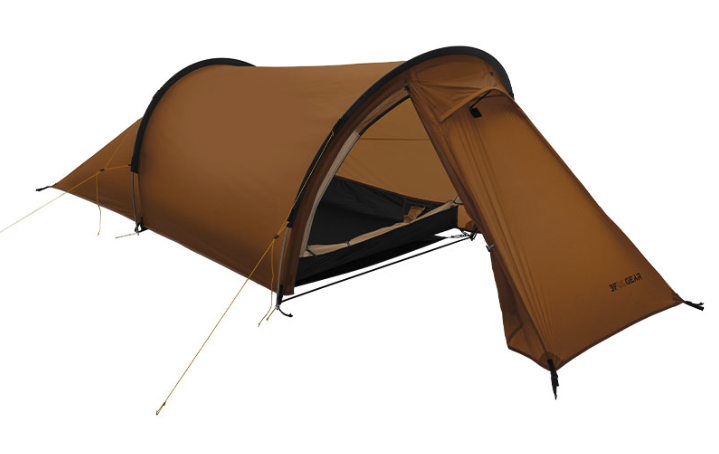
Its greatest strength: wind stability. If the pegs are secure at the front and back, it handles storms without any trouble. There's an impressive wind test on YouTube by a British hiker.
The inner tent clips into the flysheet, so you can pitch it even in torrential rain without the inner getting wet. Handily, the door opens to either side – so you can always open it on the sheltered side, away from the wind. And you can open it without the inside getting wet. You can even cook in the vestibule while it's raining. The ultimate bad weather tent – though of course it works brilliantly in good weather too.
What You Should Know
The Taihang isn't freestanding. You need at least six pegs, more if you want it really stable. The tent comes in khaki (brown) and bright orange. A groundsheet to protect the tent floor is included.
The tent weighs 1,790g (without footprint) – not ultralight, but perfectly reasonable for a stormproof two-person tunnel tent. The packed size is also a bit larger, though according to the manufacturer the poles are only 40cm long, not nearly 50cm as the packed size might suggest. The tent comes in a sturdy-looking, waterproof bag that you could strap directly to a rear rack or MTB handlebars.
The Taihang is only available direct from the manufacturer, in khaki (brown) and bright orange.
3F UL Gear Taihang 2 at a Glance
Model | Weight (g) | Packed size (cm) | Price (€) | Shop* |
3F Taihang 2 | 1.790 (ohne Footprint 170g) | 50x13 (Ø) | 150 |
Our Verdict: A lovely tunnel tent for anyone who's often out in rough weather. Britain, Scandinavia, coastal tours – this is where the Taihang really comes into its own.
3F UL Gear Floating Cloud – Similar to the Naturehike Mongar
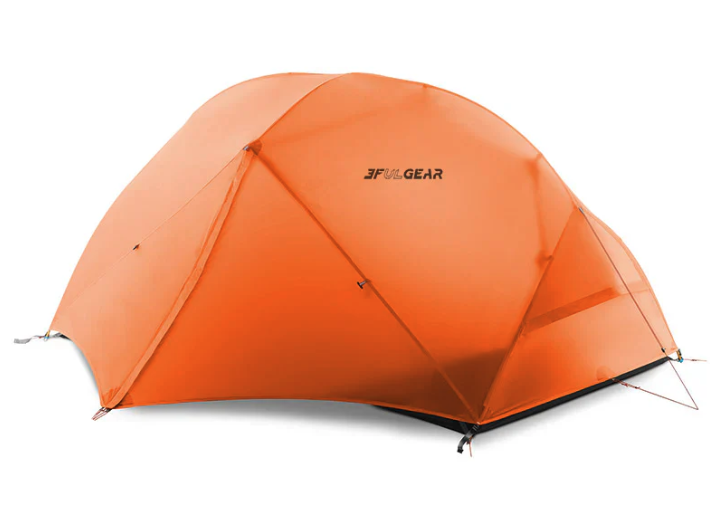
3F also has a classic dome tent in their range: the Floating Cloud. Double-walled, freestanding apart from the doors, with a single-piece pole system for quick pitching. And the tent comes in a lovely orange – not just camouflage colours for once!
The Floating Cloud 1 weighs around 1,342g (15D version) – roughly the same as the Naturehike Mongar 1 UL. The Floating Cloud 2 weighs around 1,780g, so about 110g more than the Mongar 2 UL.
The reviews we found online are consistently positive: easy to pitch, waterproof, robust. Many users report it holding up well in storm and rain tests.
3F Floating Cloud Models at a Glance
Model | Weight (g) | Price (€) | Shop* |
|---|---|---|---|
Floating Cloud 1 (15D) | 1.342 | 165 | https://3fulgear.com/product/freestanding-tent/floating-cloud-1/ |
Floating Cloud 2 (15D) | 1.780 | 180 | https://3fulgear.com/product/freestanding-tent/floating-cloud-2/ |
Our Verdict: A very good alternative to the Naturehike Mongar – especially if you don't want camouflage colours!
Our Verdict: The Best Tents for Bikepacking
The perfect tent doesn't exist. We cycle tourists and bikepackers all have different needs. Some want to travel as light as possible and are willing to compromise on comfort. For others, weight isn't so important – they want space and comfort. Most of us fall somewhere in between.
Weather matters too. In rainy, windy Norway, I'd take a different tent than in southern Spain. Still, here are a few recommendations:
Our Recommendation for Solo Bikepackers
If weight and packed size are your priority: the 3F Lanshan 1 (without Pro). Ultralight, incredibly compact, a true classic. Drawback: you need lots of pegs and have to buy the pole separately.
If you prefer something simpler and more comfortable: a freestanding tent like the Naturehike Cloud Up 1 or 2 (from 1,220g or 1,350g respectively), the Mongar 1 UL (1,340g) or the Floating Cloud 1 from 3F (1,340g). No pitching stress, few pegs needed.
If you want to spend as little as possible: the Naturehike Tagar 1 (single-walled, 1,150g, €100) or the Cloud Up 1 210T (freestanding, double-walled, €90).
Also very interesting: the Naturehike Daban 1 (997g) – a tunnel tent, single-walled, particularly wind-stable. Unfortunately there aren't many reviews of this tent yet.
Our Recommendation for Two People on a Cycle Tour
Our favourite for travelling as a pair: the Naturehike Star River 2 UL. Spacious, two doors, two vestibules, great stuff sacks. Though it's also one of the pricier options.
For rough conditions: the 3F UL Gear Taihang 2. Particularly wind-stable, easy to pitch in the rain, and the door can stay open even when it's raining.
If you want to go cheap and light: the Naturehike Tagar 2. Single-walled, just 1,290g, €100. But you'd better like each other and not be afraid of a bit of condensation ;)
All Featured One-Person Tents (Sorted by Weight)
Model | Weight(g) | Packed size (cm) | Price (€) | Shop* |
3F Lanshan 1 Pro | 908 (incl. Pole 82g) | 34x15 (Ø) | 150 + Pole | https://3fulgear.com/product/ultralight-tent/lanshan-1-pro/?currency=EUR |
Naturehike Daban 1 | 997 | 40x14 (Ø) | 172 | |
3F Lanshan 1 | 1.002 (incl. Pole 82g) | 34x15 (Ø) | 130 + Pole | |
Night Cat Lanshan 1 | 1.132 (incl. Pole 82g) | 33x14,3 (Ø) | 150 + Pole | |
Naturehike Tagar 1 (20D) | 1.150 | 44x10 (Ø) | 100 | |
Naturehike Cloud Up UL 1 (15D) | 1.220 | 39x13 (Ø) | 140 | |
Simond MT900 | 1.300 | 39x10,5 (Ø) | 189,99 | |
Naturehike Cloud Up 1 (20D) | 1.330 | 41x13 (Ø) | 120 | |
Naturehike Mongar 1 UL (15D) | 1.340 | 40x14 (Ø) | 144 | |
3F Floating Cloud 1 (15D) | 1.342 | - | 165 | https://3fulgear.com/product/freestanding-tent/floating-cloud-1/ |
Naturehike Cloud Up Pro 1 (20D) | 1.360 | 39x13 (Ø) | 130 | |
Naturehike Cloud Up 1 (210T) | 1.500 | 41x13 (Ø) | 90 |
All Featured Two/Three-Person Tents (Sorted by Weight)
Model | Weight (g) | Packed size (cm) | Price (€) | Shop* |
3F Lanshan 2 Pro | 1.198 (incl. 2 poles at 82g each) | 34x15 (Ø) | 170 + 2 poles | |
Naturehike Tagar 2 (20D) | 1.290 | 44x10 (Ø) | 100 | |
3F Lanshan 2 | 1.316 (incl. 2 poles at 82g each) | 35x15 (Ø) | 140 + 2 poles | https://3fulgear.com/product/ultralight-tent/lanshan2-classic/ |
Naturehike Cloud Up UL 2 (15D) | 1.350 | 40x13 (Ø) | 190 | |
Naturehike Cloud Up Pro 2 (20D) | 1.530 | 40x13 (Ø) | 140 | |
Naturehike Cloud Up 2 20D | 1.550 | 45x12 (Ø) | 130 | |
Naturehike Star River 2 UL (15D) | 1.620 | 40x13 (Ø) | 190 | |
Night Cat Lanshan 2 | 1.624 (incl. 2 poles at 82g each) | 40x16 (Ø) | 180 + 2 poles | |
Naturehike Mongar 2 UL (15D) | 1.670 | 41x15 (Ø) | 180 | |
3F Floating Cloud 2 (15D) | 1.780 | - | 180 | https://3fulgear.com/product/freestanding-tent/floating-cloud-2/ |
3F Taihang 2 | 1.790 | 50x13 (Ø) | 150 | |
Naturehike Cloud Up 3 20D | 1.850 | 51x18 (Ø) | 150 | |
Naturehike Cloud Up 2 210T | 1.900 | 41x13 (Ø) | 105 | |
Naturehike Mongar 2 (20D) | 1.900 | 50x15 (Ø) | 115 | |
Naturehike Star River 2 (20D) | 1.900 | 45x15 (Ø) | 130 |
Which tent do you find most interesting? Have we missed a good tent for under €200? Do you have experience with any of these tents? Let us know in the comments!
*We use affiliate links in some places to help support BikeTouri financially. The price stays the same for you!